


Is It Mommy’s Thumb or Carpal Tunnel Syndrome?
Learn the Cause of Your Hand and Wrist Symptoms
Published October 2025
If you've been experiencing swelling and pain on the thumb side of the wrist, it's likely not carpal tunnel syndrome. That type of pain is more often due to de Quervain's tenosynovitis — also called "mommy's thumb" or "mommy's wrist" because it can develop from lifting and holding a baby.
Both are common conditions, but carpal tunnel syndrome affects more people than de Quervain's tenosynovitis. Up to 6% of adults in the United States experience carpal tunnel syndrome.
De Quervain's tenosynovitis affects about 1% of adults in the United States every year. It's more common in women, especially in new parents, those who are pregnant and people 30 to 50 years old. However, anyone can develop it.
If holding a baby, make sure you’re cupping your hand.— Ellen Kroin, MD
How do you know which condition is causing the symptoms in your hands and wrists? One clue is the location of symptoms.
"People often think they have carpal tunnel syndrome when it's really de Quervain's tenosynovitis," says Northwestern Medicine Orthopaedic Surgeon Ellen Kroin, MD. "But de Quervain's tenosynovitis is associated with the tendons and their protective sheath on the thumb side of the wrist, and carpal tunnel syndrome is associated with the median nerve in the palm side of the wrist."
Learn how to spot other differences between these conditions.
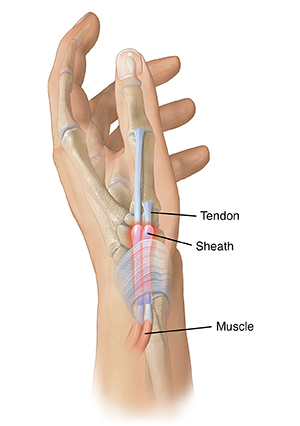
What Is De Quervain's Tenosynovitis?
De Quervain's tenosynovitis is a common form of tendonitis that affects two tendons on the thumb side of the wrist. It's named after the surgeon who first wrote about it.
This condition can cause tenderness, pain or a snapping sensation when you make a fist, turn your wrist or grasp something. The tendons in the wrist and sheath that protects them become inflamed, which can cause pain to travel down the affected thumb or up the forearm.
What Is Carpal Tunnel Syndrome?
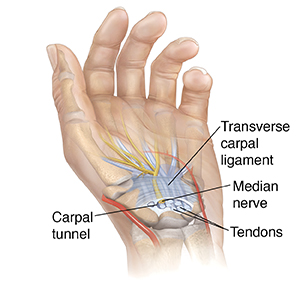
Carpal tunnel syndrome is caused by pressure on the median nerve. This nerve runs along the length of your arm and passes through the carpal tunnel — a passageway through the carpal bones and tendon at the base of your wrist.
The median nerve provides feeling to the palm side of the thumb, index and middle fingers, and half of the ring finger. This nerve also provides signals to muscles around the base of the thumb (called the thenar muscles), which help with movement. Weakness in this group of muscles can make it more difficult to grip and use your fingers to do everyday tasks, like buttoning a shirt.
Differences Between De Quervain's Tenosynovitis and Carpal Tunnel Syndrome
Affected areas
- De Quervain's tenosynovitis: Base of the thumb and thumb side of the wrist, may radiate up the forearm
- Carpal tunnel syndrome: Palm side of the thumb, index, middle and part of the ring finger
Causes
- De Quervain's tenosynovitis:
- Daily activities that involve repetitive motion like writing, typing, texting, and lifting and holding a baby
- An injury or trauma to the tendons in the thumb
- Overuse of the thumb and wrist
- Hormonal changes during pregnancy
- Carpal tunnel syndrome:
- Anything that puts pressure on the median nerve, including:
- Strain injuries from repetitive movement
- Poor wrist mechanics
- Wrist fractures and sprains
- More likely with pregnancy and specific medical conditions, including rheumatoid arthritis, gout, hypothyroidism and diabetes
"People with these conditions are more at risk of hand and wrist symptoms because they have a higher state of inflammation," says Dr. Kroin.
Symptoms
When tracking your symptoms, notice how the discomfort shows up. De Quervain's tenosynovitis is mostly pain-based, while carpal tunnel syndrome often involves numbness and tingling.
- De Quervain's tenosynovitis:
- Pain, tenderness and swelling in the base of the thumb and wrist
- Difficulty using the thumb when gripping an object
- A popping or clicking feeling when moving the thumb
- Carpal tunnel syndrome:
- Numbness in your wrist, hand or thumb, index, middle and ring fingers (especially your fingertips)
- Tingling or a pins-and-needles sensation, which can feel like your hand fell asleep
- Pain that feels sharp, burning or like a constant ache
- Weakness in your grip or trouble holding objects, such as picking up a glass of water
- Reduced coordination in your fingers, hand and wrist
Timing and progression
- De Quervain's tenosynovitis: Symptoms may appear gradually or all at once, any time.
- Carpal tunnel syndrome: Symptoms of carpal tunnel syndrome usually develop gradually and can get worse over time. You might first notice them at night since they can wake you up from your sleep. You may feel like you need to move or shake your hands to relieve the numbness and feeling of pins and needles.
Getting the Right Diagnosis
Your physician can help you get to the root cause of your hand and wrist symptoms during a physical exam. There are several ways to diagnose carpal tunnel syndrome and one primary way to diagnose de Quervain's tenosynovitis.
For a diagnosis of carpal tunnel syndrome, your physician may use the following tests:
- Tinel's sign
- Phalen's test
- Ultrasound
- Electromyography
The primary test for de Quervain's tenosynovitis is the Finkelstein test. For this test, you'll make a fist with your fingers wrapped over your thumb. Holding the fist, you'll move your wrist as if you are shaking someone's hand. If you have de Quervain's tenosynovitis, this movement usually causes you to feel pain when you move your wrist.
But can you have both de Quervain's tenosynovitis and carpal tunnel syndrome? Dr. Kroin says it's possible. "They're different conditions and affect different parts of the hand and wrist, so you can have them at the same time," she says.
Treatment Options
There are several treatment options for de Quervain's tenosynovitis and carpal tunnel syndrome:
- Wear a splint or brace to limit thumb and wrist movement.
- For carpal tunnel syndrome, a wrist splint is often worn at night to keep the wrists from flexing and putting pressure on the median nerve.
- For de Quervain's tenosynovitis, a special brace called a thumb spica brace immobilizes the base of the thumb.
- Your physician can fit you for a wrist or thumb brace to make sure you are wearing the correct size.
- Ice your wrist for 10 to 20 minutes a few times a day.
- Take nonsteroidal anti-inflammatory drugs (NSAIDs), which includes anti-inflammatory medications, such as ibuprofen, to reduce inflammation and relieve pain. NSAIDs are not recommended during pregnancy.
- Work with an occupational therapist who specializes in hand therapy to increase flexibility and strengthen the hand and wrist muscles.
- Take frequent breaks and avoid repetitive thumb and wrist movements.
"For de Quervain's tenosynovitis, be diligent with how you position your thumb when lifting anything," says Dr. Kroin. "If holding a baby, make sure you're cupping your hand — instead of extending your thumb to the side — to support the baby's head. Avoid putting strain on your tendons and rest them as much as possible."
Corticosteroids for reducing pain and inflammation can also help. They can be taken as a pill or your physician may give you a cortisone shot, a type of corticosteroid injection.
Surgical treatments
If your pain is not getting better, surgery is an option for both conditions. It can relieve pressure on the median nerve for carpal tunnel syndrome or release the tendon sheath for de Quervain's tenosynovitis. Surgery is only considered if other treatments don't work.
"Surgery for carpal tunnel syndrome is more common than surgery for de Quervain's tenosynovitis," says Dr. Kroin. "Carpal tunnel syndrome that is not treated can lead to weakness and nerve damage, making surgery more likely."
If you need surgery to treat carpal tunnel syndrome, your surgeon may perform a procedure called carpal tunnel release. This will help create more space and reduce tension on your median nerve. "This surgery is considered the gold standard when other treatments don't work because it decompresses the nerve," says Dr. Kroin.
Surgery for carpal tunnel syndrome is typically an outpatient procedure, which means you can go home the same day.
Recovery may be gradual, but the surgery can help address symptoms in the long term. In severe cases, untreated nerve damage can be permanent.
When to See a Physician
If you're still experiencing hand and wrist symptoms and you've tried at-home treatments, call your primary care physician. They can help you decide if you need to schedule an appointment to see an orthopaedic surgeon (a physician who specializes in bones, joints, muscles, ligaments and tendons) with a specialty in hand surgery for further evaluation.
Featured Experts


 Chrome
 Edge
Edge Safari
 Firefox