


Colorectal Cancer: Risk Factors, Early Signs and Screening
Understanding Your Personal Risk Can Guide Screening Decisions
Updated March 2026
Colorectal cancer remains a common diagnosis in the United States, with nearly 160,000 people diagnosed each year, according to the American Cancer Society. It is also a leading cause of cancer death in people under 50, driven by rising rates among younger adults.
These realities underscore the importance of regular screening. The American Cancer Society recommends that most adults at average risk begin colorectal cancer screening at age 45.
Having a colorectal cancer risk factor doesn’t guarantee you will develop colorectal cancer.— Christian G. Stevoff, MD
Colorectal cancer is an umbrella term that includes both colon cancer and rectal cancer. Colon cancer begins in the large intestine, while rectal cancer develops in the rectum.
Many people diagnosed with colorectal cancer have no symptoms at all, especially in early stages. Still, learning the signs and risk factors can make a meaningful difference, says Christian G. Stevoff, MD, a gastroenterologist at Northwestern Medicine.
“Having a colorectal cancer risk factor doesn’t guarantee that you will develop colorectal cancer,” says Dr. Stevoff. “And having symptoms doesn’t automatically mean cancer. But knowing your risks and communicating your symptoms to your doctor can be vital in detecting colorectal cancer early."
Who Is at Increased Risk?
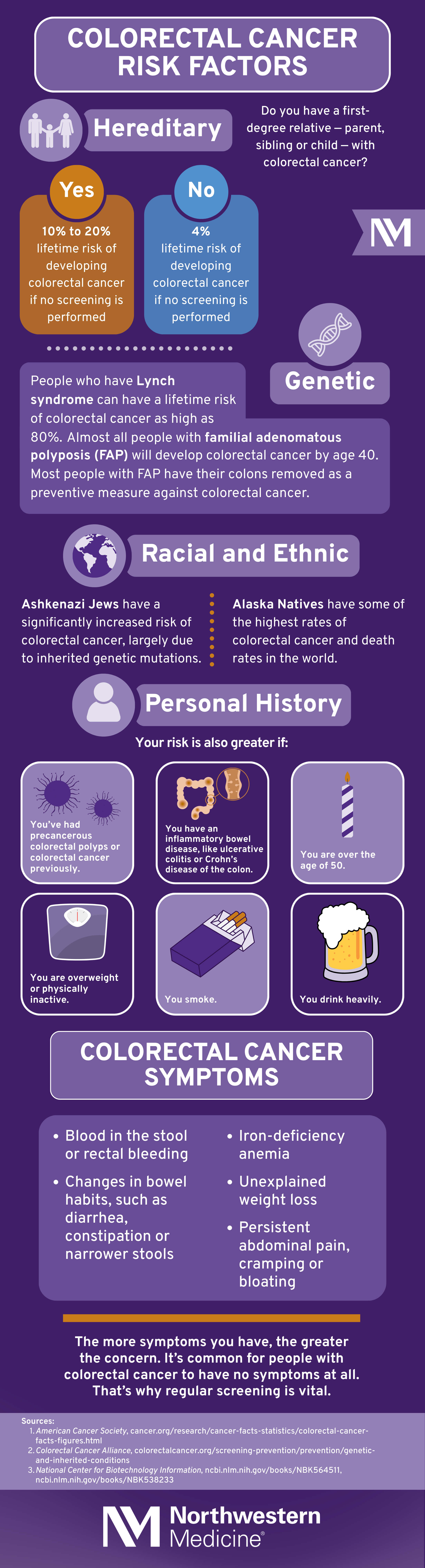
People at increased risk include those with a history of:
- Colorectal cancer or precancerous colorectal polyps
- Inflammatory bowel disease, such as ulcerative colitis or Crohn’s disease of the colon
- Inherited genetic conditions, including:
- Lynch syndrome, which is associated with a significantly higher lifetime risk of colorectal cancer
- Familial adenomatous polyposis (FAP), in which nearly all people will develop colorectal cancer without preventive surgery
Other key risk factors include:
- Age: Risk increases with age, even though colorectal cancer is rising in adults under 50.
- Family history: Having a first-degree relative (parent, sibling or child) with colorectal cancer or precancerous polyps raises risk, especially if the cancer diagnosis occurred before age 60.
- Racial and ethnic background:
- Ashkenazi Jews (people of Eastern European Jewish descent) have a significantly increased risk of colorectal cancer compared with the general population, largely due to inherited genetic mutations.
- Alaska Natives have some of the highest rates of colorectal cancer and death rates in the world.
- Lifestyle factors:
- Smoking
- Moderate to heavy alcohol use
- Being overweight or physically inactive
- Long-term diets high in red or processed meats
For people at increased risk of colorectal cancer, doctors often recommend starting screening earlier than age 45, with colonoscopy as the preferred screening test.
Having one or more risk factors does not mean you will develop colorectal cancer. However, understanding your personal risk can help guide screening decisions and support early detection, when treatment is most effective.
Screening Options and Timing
For people at average risk:
- Screening is recommended between ages 45 and 75.
- Screening may continue up to age 85 based on your overall health and life expectancy.
- Colonoscopy is recommended every 10 years; other approved screening options can be used at their recommended intervals.
- Any abnormal result from a non‑colonoscopy test should be followed by a timely colonoscopy.
Screening options include:
- At-home stool (poop) tests:
- Fecal immunochemical test (FIT) every year: Checks for traces of blood in your stool, which can be an early sign of colon cancer
- Guaiac-based fecal occult blood test (gFOBT) every year: Checks for blood in your stool, similar to the FIT
- FIT DNA test every three years: Checks for blood and DNA changes linked to cancer or polyps
- CT colonography (virtual colonoscopy) every five years: A CT scan of the colon that looks for polyps or cancer
- Flexible sigmoidoscopy every five years: A scope exam that examines the lower part of the colon for polyps or cancer
- Colonoscopy (the most complete screening test) every 10 years: An exam that looks at the entire colon and can remove polyps during the same procedure
These recommendations apply to people without symptoms. If symptoms develop, talk with your doctor promptly and without delay, even if you are younger.
Early detection plays a major role in outcomes. When colorectal cancer is found early, before it has spread, the five‑year survival rate is about 90%, according to the Cancer Research Institute.
Why Colorectal Cancer Is Considered Preventable
Colorectal cancer is one of the most common cancers in the United States, but it is also one of the most preventable. Regular screening can find and remove precancerous polyps before they turn into cancer. While overall survival across all stages is about 65%, outcomes improve dramatically when cancer is found early.
Although age remains a major risk factor, colorectal cancer is increasingly diagnosed in adults under 50, with incidence rising about 3% per year in this age group (20 to 49). Scientists continue to study why this trend is occurring, but lifestyle and environmental factors are believed to play a role.
Common Signs and Symptoms of Colorectal Cancer
Colorectal cancer can develop without noticeable symptoms, which is why screening before symptoms appear is so important. When symptoms do occur, they may include:
- Blood in the stool or rectal bleeding
- Changes in bowel habits, such as diarrhea, constipation or narrower stools
- Persistent abdominal (belly) pain, cramping or bloating
- Unexplained weight loss
- Iron‑deficiency anemia, which can cause fatigue
Some symptoms are commonly mistaken for conditions like hemorrhoids or irritable bowel syndrome. Colon and rectal cancer share many symptoms, but rectal cancer may be more likely to cause a feeling of incomplete bowel emptying or changes in stool shape. Cancers on the right side of the colon may cause anemia without visible bleeding.
Any symptom that lasts more than a couple of weeks should be evaluated by your doctor.
“No amount of rectal bleeding should be ignored,” says Dr. Stevoff.
Symptoms, such as unexplained weight loss, persistent abdominal pain or ongoing changes in bowel habits, deserve attention at any age. A primary care physician is often the best first step, with referral to a gastroenterologist or other specialist when needed.
“Listen to your body and talk with your doctor about screening or any new symptoms. It’s one of the most important steps you can take for your health,” says Dr. Stevoff.
Use this simple screening tool to spot potential colorectal risks early and get guidance for your next steps.
 Download Colorectal Cancer: Risk Factors, Early Signs and Screening
Featured Experts




 Chrome
 Edge
Edge Safari
 Firefox