

Improving Brain Tumor Diagnosis With DNA Methylation Testing
A More Precise Way to Classify Tumors and Guide Treatment
Updated October 2025
Every brain tumor is different. An accurate diagnosis is critical for figuring out the proper treatment plan. A breakthrough testing method called genomic DNA methylation profiling is giving physicians a clearer picture.
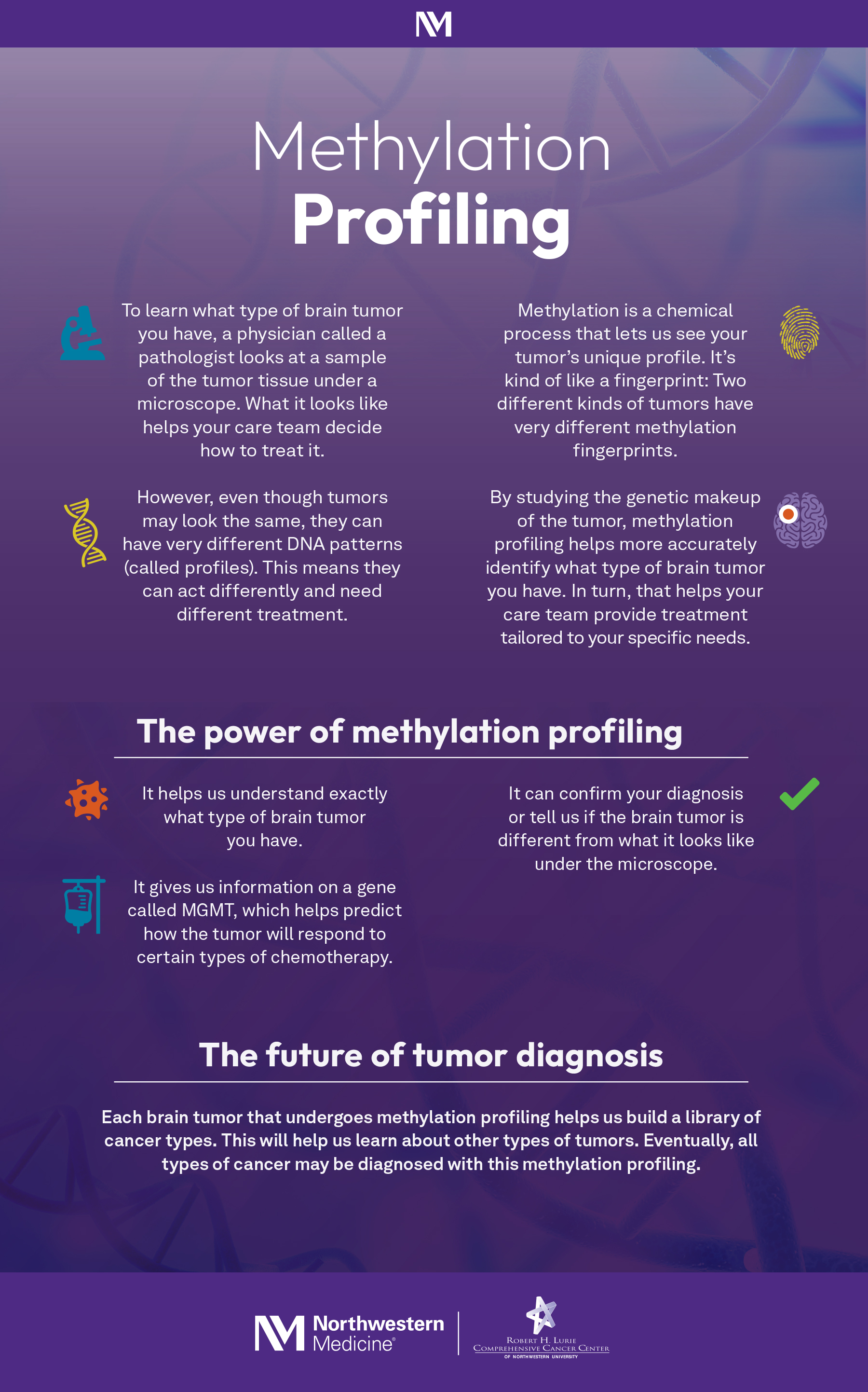
This test looks at the unique “fingerprint” of a tumor, known as its methylation profile. Analyzing this fingerprint helps physicians classify and diagnose brain tumors more accurately.
Methylation profiling may become part of the workup for essentially all cancer types— Rudy Castellani, MD
“Methylation profiling is a very powerful diagnostic tool that allows us to classify tumors based on empirical molecular signatures,” says Rudy Castellani, MD, a neuropathologist at Northwestern Medicine. “It’s viewed more and more as the way of the future — the next big thing in the diagnosis of cancer.”
Through Lou and Jean Malnati Brain Tumor Institute of Robert H. Lurie Comprehensive Cancer Center of Northwestern University at Northwestern Memorial Hospital, Northwestern Medicine was one of the first centers in the world to offer methylation profiling to diagnose brain tumors.
How Methylation Profiling Works
Each cell in your body has genetic material called DNA. Cells can chemically modify parts of their DNA through a process called methylation. These modifications create unique patterns that help physicians identify and categorize different tissues — from skin to bowel to lung — as well as tumors.
A tumor’s unique DNA methylation profile can tell physicians more about it, including:
- What kind of tumor it is
- The origin of the tumor
- How it may respond to certain therapies
Methylation profiling also makes it possible to tell the difference between brain tumors that may look similar under the microscope. This can lead to a more effective treatment plan.
A More Accurate Diagnosis
Traditionally, brain tumors have been diagnosed by what pathologists see under the microscope, which is a tissue sample of the brain tumor that was removed during surgery.
"Historically, we classified tumors based on cell of origin and degree of malignancy, what kind of general cancer is present and the grade," says Dr. Castellani. "With methylation profiling, we can provide more details and tumor grouping based on the accumulating molecular knowledge. This means we can determine how to treat the cancer with greater specificity, resulting in better outcomes."
Better Brain Tumor Treatment Plans
This technology could make the difference between an accurate and an inaccurate diagnosis. According to Dr. Castellani, methylation profiling refines a brain tumor diagnosis or provides a more detailed characterization for up to a third of patients.
"Methylation profiling is proving to be a game-changer," says Dr. Castellani. "In many cases, tumors thought to be one subtype under the microscope ended up being in a different category. It’s turning out to be a form of quality assurance in addition to elucidating new classes of tumors not previously described."
Diagnosis drives treatment plans for patients with brain tumors, and methylation profiling could improve health outcomes for these patients. By providing a more accurate tumor classification, this technology can inform appropriate treatments plans for any given tumor.
Dr. Castellani predicts that this technology will eventually be used routinely for cancers beyond the brain, such as leukemia and metastatic cancers of unknown origin. "As time goes on, methylation profiling may become part of the workup for essentially all cancer types," he says.
Featured Experts



 Chrome
 Edge
Edge Safari
 Firefox