

Laser Vision Correction and Refractive Surgery
Our Laser Vision Correction and Refractive Surgery program offers advanced treatments such as LASIK and other procedures to reduce dependence on glasses and contact lenses. We provide personalized evaluations and care to help patients achieve clearer vision and improved visual freedom.
The goal of refractive eye surgery is to improve your vision so you need glasses or contacts less — or even not at all. Our experienced surgeons thoroughly evaluate each patient to determine if they’re a candidate for laser vision correction. They use the leading-edge technology to plan and deliver a treatment customized for you.
Our LASIK eye surgeons will be with you at every step to answer questions and make sure you are comfortable with your treatment plan.
Our Technology
Experience, expertise and advanced technology differentiate Northwestern Medicine LASIK Physicians from other providers. At Northwestern Medicine LASIK Physicians, we are committed to using state-of-the-art LASIK technology to deliver personalized patient care. We’ve invested in the latest LASIK technology and are highly skilled in using it to optimize treatment plans and outcomes.
EVO Visian Implantable Collamer LensTM
EVO Visian Implantable Collamer Lens (ICL) is placed in your eye to permanently correct nearsightedness and nearsightedness with astigmatism. The lens is placed behind the iris and in front of the natural lens to help your eye focus light onto your retina correctly.
Before your surgery, you will have an eye exam to get the measurements needed.
The surgery is performed one eye at a time, one to two weeks apart. Each surgery takes about 30 to 45 minutes. Because this surgery will affect your vision and make it unsafe for you to drive, it is important to ask someone to take you home after your surgery.
iDesign® Refractive Studio
Northwestern Medicine LASIK Center was the first in Illinois to offer LASIK using the iDesign Refractive Studio, which allows our surgeons to more accurately measure your eye and deliver personalized treatments using topography-integrated wavefront-guided technology.
Older wavefront-guided systems measure 240 individual areas on your cornea to create a LASIK treatment plan. iDesign measures 1,251 areas to create a more detailed corneal profile and treatment plan.
iDesign is approved for people over 18 with a stable glasses/contact lens prescription. This technology can treat a wider range of people with nearsightedness, farsightedness and astigmatism than previous wavefront-guided treatments.
Additionally, it is the only available LASIK technology platform indicated for wavefront-guided monovision LASIK in patients with nearsightedness and presbyopia. Monovision is a procedure designed for patients over 40 who are experiencing blurry near vision due to aging of their eyes.
IntraLase®/Bladeless
LASIK requires the creation of a corneal flap. This step has traditionally been performed with a surgical blade called a microkeratome, but the IntraLase laser allows a “blade-free” procedure. IntraLase uses state-of-the-art computer technology to create a corneal flap during the first stage of the LASIK procedure.
The use of IntraLase technology may make it possible to treat more patients, including those with thin corneas who were not candidates for LASIK with older technology.
Monovision LASIK
Monovision LASIK is a surgical technique in which one eye is corrected for distance vision and the other eye is corrected for reading vision. This version of LASIK is typically performed only on patients over 40 and is one way that an older patient can reduce or eliminate the need for reading glasses.
Although many people who undergo Monovision LASIK are satisfied with their new vision, we typically ask each patient to undergo a contact lens trial prior to having the actual surgery because this will simulate what Monovision LASIK results will be like.
VISX Star 4 IR® Excimer Laser
Northwestern Medicine LASIK Physicians offers patients the unparalleled technology and precision of the VISX Star 4 IR excimer laser, the most popular laser in the United States.
The VISX Star 4 IR has several advantages. The VISX Star 4 IR offers variable spot beam technology for quicker treatment times and less corneal tissue removal. The Star 4 IR also provides a larger treatment zone, variable spot-scanning technology for more accurate laser treatment, and quicker healing time with fewer complications. A feature called 3-D active eye tracking allows for precise laser targeting despite eye movement.
Iris Registration
Iris registration works with the CustomVue Wavefront system to ensure precise pupil alignment during laser treatment. It tracks the position of your eye and adjusts the laser to account for any fine movements of your eye. This adds an additional level of safety to the procedure.
Iris registration is only available with CustomVue LASIK treatment.
Conditions
Tests
- Biometry
- Corneal Topography
- Slit Lamp and External Photography
Treatments
Meet the Team
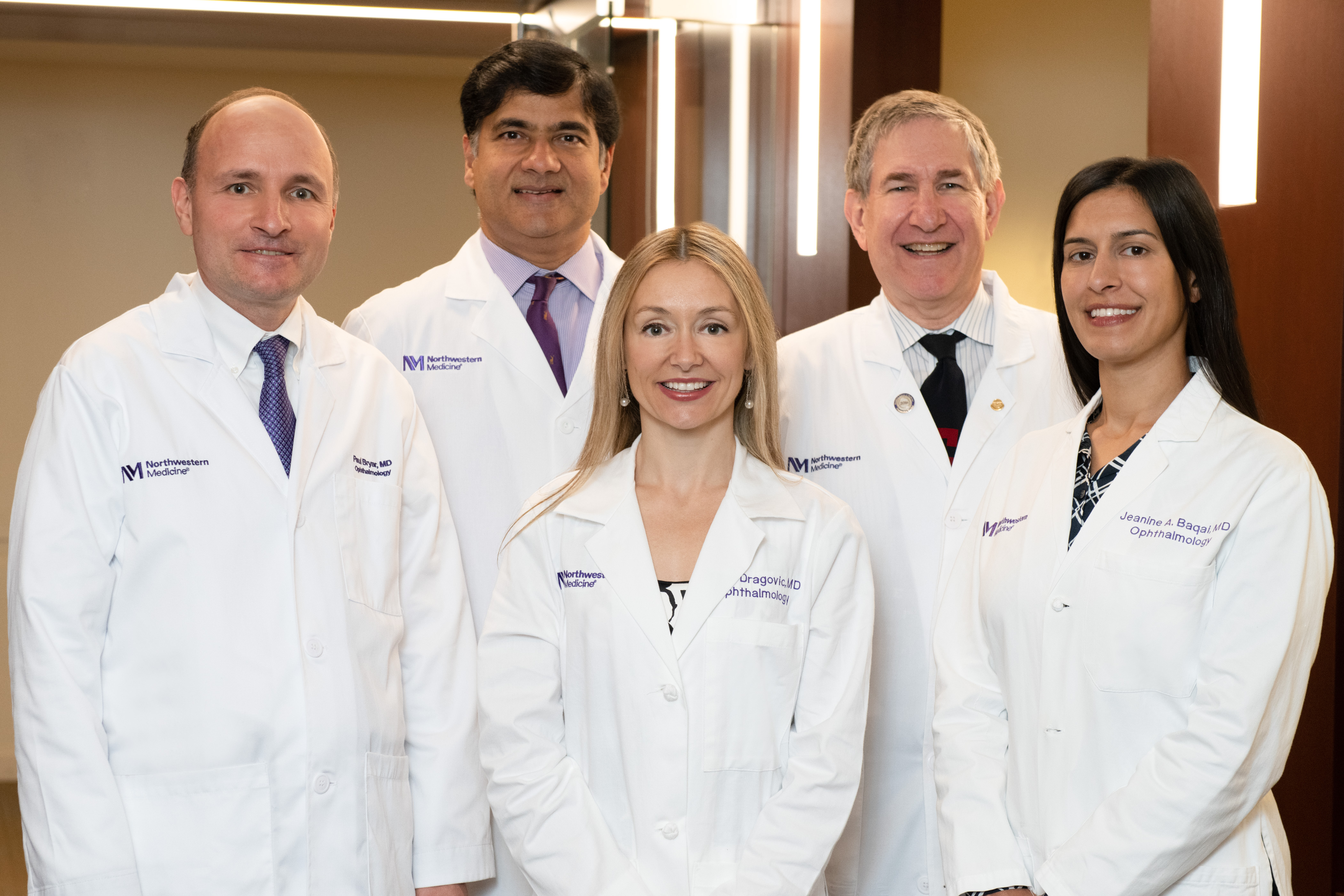
The Northwestern Medicine LASIK Center, located in downtown Chicago, is staffed by highly experienced ophthalmologists. This team is committed to understanding the needs of each patient and uses state-of-the-art technology to deliver excellent patient care.
 Chrome
 Edge
Edge Safari
 Firefox