


Why Stretching Is More Important Than You Think
How to Add Flexibility to Your Cardio and Strength Training Routine
Published October 2025
You’ve likely heard about the importance of stretching and might think it’s only for athletes and people training for marathons. But stretching is for everyone, and ideally, you should include it as part of your daily activities at least a few times a week.
With more than 600 muscles in the body, there are a lot of muscles to stretch. How do you know what types of stretches to do, and does stretching really increase flexibility?
Learn specific stretching exercises you can do and why you should stretch.
Why Should You Stretch?
There is no one-size-fits-all for stretching.— Brian Kura, PT, DPT
Stretching helps your muscles stay flexible, which allows your joints to maintain their full range of motion. Without stretching the muscles regularly, muscles tighten. When muscles are tight, it can cause joint pain and muscle strains, increasing your chance of injury.
“When you stretch, there is an effect on both the muscle itself and the surrounding connective tissue,” says Northwestern Medicine Physical Therapist Brian Kura, PT, DPT. “This combined effect allows the joint that’s involved to move more freely without restriction or increased compression.”
There is also a nerve component to stretching. “This can lead to restriction in range of motion and the intense sense of stretch that some people feel when doing certain stretches like a hamstring stretch,” he says.
While stretching, you’ll feel some tension, but you shouldn’t feel pain.
Areas of Focus
Although there isn’t a specific set of stretches you should do every day, aim for a few stretches daily. Focus on covering the major muscle groups and areas needed for everyday mobility.
Some areas to focus on in your upper body:
- Neck
- Shoulders
- Back
Some areas to focus on in your lower body:
- Hip flexors (front of hips)
- Hamstrings
- Quadriceps (front of thighs)
- Calves
Types of Stretching
There are several stretching techniques. Two of the most common are dynamic stretching and static stretching. Both are different types of stretching.
Dynamic stretching
Dynamic stretching is moving through a range of motion with active movements instead of holding the stretch. This type of stretching is a great warm-up before exercise.
“It helps increase circulation and core body temperature, and preps your body for the activity,” says Kura. “This type of stretching is ideal for daily routines because it reduces your risk of injury.”
Although it’s the most effective type of stretching before a workout, dynamic stretching can also help after exercise by reducing muscle soreness.
Examples of dynamic stretches
Here are a few examples of dynamic stretches.
Arm circles
- Stand with your feet flat on the ground hip-distance apart. Reach your arms out to a “T” position at shoulder height.
- In a forward motion, slowly circle your arms. Start with small circles and gradually let the circles get larger.
- After 30 circles, reverse directions.
Arm swings
- Stand with your feet hip-distance apart. Slowly swing your arms wide in a “T” position and cross your right arm over your left arm as you swing your arms in toward your chest.
- Swing them back out to a “T” position and repeat, alternating the arm that’s on top each time.
- Continue for up to one minute.
Stand and squat
- Stand with your feet a little wider than hip-distance apart.
- With your arms straight at your sides, bend your knees.
- Move your glutes (buttocks) back as you squat and reach your hands toward your toes.
- Stand up and repeat for up to one minute.
Static stretching
Static stretching is when you hold a stretch, typically between 15 to 30 seconds. Similar to dynamic stretching, static stretching can increase your flexibility and range of motion.
“Static stretches can also help improve muscle length over time,” says Kura.
This type of stretching can help relax muscles and reduce tension. It’s typically done after a workout.
Examples of static stretches
Here are a few examples of static stretches.
Triceps stretch
- Stand with your feet hip-distance apart.
- Reach your right arm toward the ceiling. Bend your right elbow and bring the palm side of your right hand to the center of your upper back with your fingers facing down.
- Place your left hand on your right elbow. Hold the stretch for up to 30 seconds and then repeat on the other side.
Seated hamstring stretch
- Sit up tall on the floor with your legs extended forward.
- Fold forward from your hips and reach your hands toward your lower legs or toes.
- Hold for up to one minute.
Butterfly stretch
- Sit up tall on the floor.
- Bring the soles of your feet together, allowing your knees to fall outward.
- Place your hands around your ankles or feet.
- Fold forward from your hips as you bring your heart toward your heels. Allow your outer legs to relax toward the ground.
- Hold this stretch for up to one minute.
More Reasons to Stretch
Whether you do these stretches or follow a different stretching routine, you’ll notice increased benefits when you stretch more over time.
For the most benefits and to prevent injuries, stretch before and after a workout. And even if you’re not exercising on a particular day, it’s still important to stretch.
“There is no one-size-fits-all for stretching. Different bodies move in different ways and have different stretching needs,” says Kura. “A good practice is to be thorough in your movement. If you notice resistance in a specific area of the body, focus your attention on stretching that area.”
Kura adds that stretching is an important part of muscle recovery. If you don’t stretch, muscles can become weak and less resistant to stress.
But don’t overdo it. Too much stretching can lead to muscle fatigue. “Gradually increase your stretching and allow time for your body to adapt and recover from physical activity,” says Kura.
And if you’re wondering, stretching won’t make you taller, but it can help your posture by helping you stand taller.
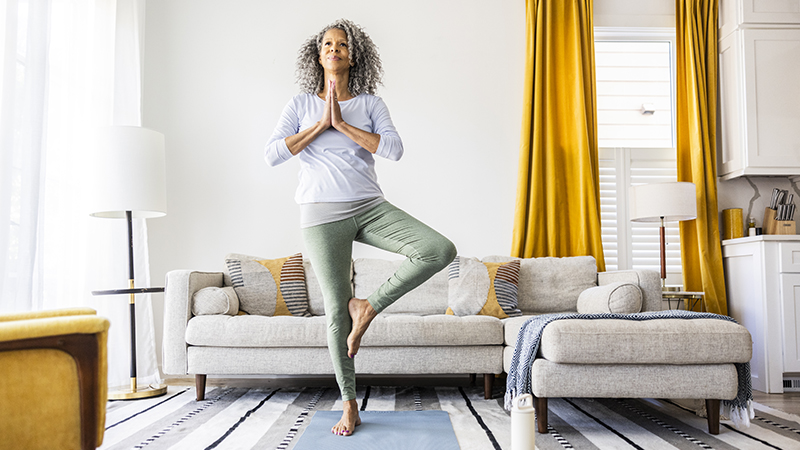
Also, yoga counts as your daily stretching. “In yoga, you do both static and dynamic stretching, so a consistent yoga practice will help you achieve similar results as a regular stretching routine,” says Kura.
Before You Begin
Check with your doctor before beginning any new exercise routine, including stretching.
- Listen to your body. If you feel pain or something feels off, modify or stop the stretch.
- Breathe slowly. Take deep inhales and exhales.
- Move mindfully. Don’t rush your movements.
If you have a medical condition or injury, a physical therapist can help teach you stretches to build muscle strength and improve your form.
Featured Experts



 Chrome
 Edge
Edge Safari
 Firefox