


The Future of Lung Cancer Screening Is Here
Lung Health Center Works To Catch Cancer Earlier and Save Lives
Published February 2026
Lung cancer remains a major health concern. It causes more deaths in the United States than breast, colon and prostate cancers combined. Almost 80% of cases are found at advanced stages, largely because symptoms often don’t appear until the disease has already progressed.
These statistics may be influenced by the common misconception that only people who have smoked develop lung cancer, combined with current screening guidelines that focus on smoking history.
A Narrow Window
A Northwestern Medicine study took a closer look at today’s U.S. Preventive Services Task Force (USPSTF) guidelines. The guidelines recommend lung cancer screening for adults age 50 to 80 who have a 20 pack-year smoking history (one pack per day for 20 years, or the equivalent amount). It also includes people who currently smoke or quit in the last 15 years. Because eligibility is based on smoking history, some people who are at risk may not meet current criteria for screening.
Based on these USPSTF guidelines, the study found that only 35% of nearly 1,000 consecutive patients treated for lung cancer at Northwestern Medicine would have qualified for screening under current guidelines. Most of the patients who would not have met screening criteria were women and people who never smoked.
A Case for Broader Screening
The study recommends expanding the screening to adults age 40 to 85. Scientists from the study estimate this could detect 94% of lung cancers and prevent more than 26,000 additional deaths each year.
“We moved to universal age-based screening for breast and colon cancer with tremendous success, and we need to move to the same approach for lung cancer,” says Ankit Bharat, MD, chief of Thoracic Surgery and executive director of Northwestern Medicine Canning Thoracic Institute. “Chest screening offers something unique — with one low-dose scan, we can assess lungs, heart and bones comprehensively. This baseline scan becomes invaluable for monitoring their health over time.”
Taking Action at the Lung Health Center
In response to the study findings, Northwestern Medicine opened the Lung Health Center at Canning Thoracic Institute. The center, made possible through generous support from John and Rita Canning, is designed to:
- Encourage and expand access to lung cancer screening for eligible patients
- Study the benefits of low-dose computed tomography (CT) scans in people who do not meet current screening criteria
- Evaluate imaging tests for signs of early heart disease, pulmonary fibrosis (scarring and thickening of lung tissue), long-term COVID‑19 effects, osteoporosis (bone-weakening disease) and other conditions
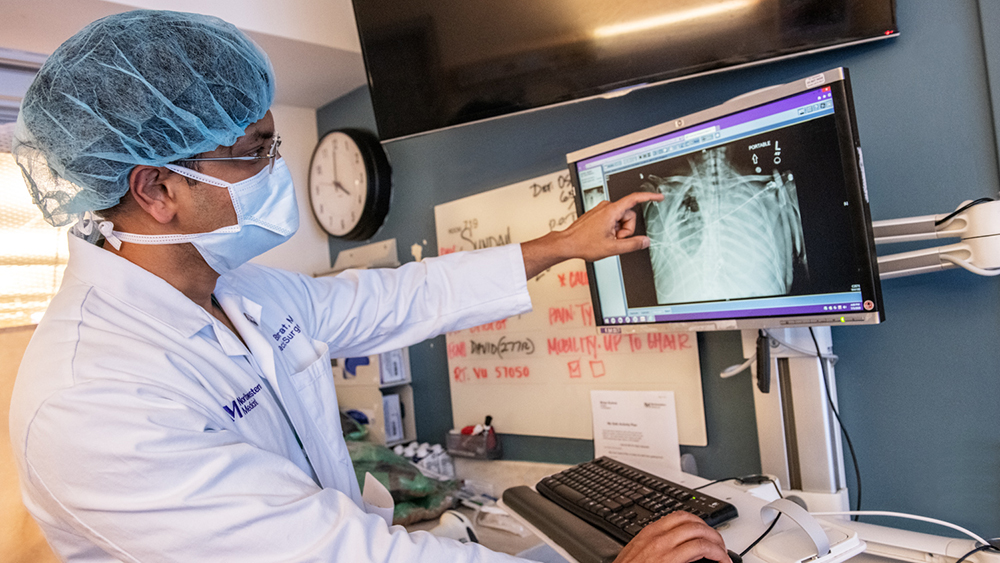
“Nearly six years after the pandemic's start, we're seeing increasing numbers of patients with lung fibrosis from COVID-19, especially those who get reinfected with respiratory viruses," says Dr. Bharat. “The damage compounds with each infection. Early detection through comprehensive screening can help us intervene before these conditions progress to requiring transplantation.”
Screening Beyond the Lungs
Low-dose CT scanning can also detect:
- Calcium deposits linked to heart disease
- Early signs of osteoporosis
- Structural changes in the lung and chest
"This initiative transforms how we approach chest health comprehensively," says Momen Wahidi, MD, an interventional pulmonologist and medical director of Canning Thoracic Institute. "Instead of waiting for symptoms to appear, we're giving patients and physicians a complete picture of chest health that can guide preventive care across multiple specialties."
Patients may discuss lung cancer screening with their physician if they have:
- Long-term symptoms after COVID‑19
- Exposure to wildfire smoke, pollution or high radon
- Family history of lung disease
- Exposure to secondhand smoke, vaping or marijuana
- Increased risk based on demographics, such as Asian women
- Interest in a baseline chest health assessment
“We're seeing younger patients with respiratory problems from vaping, environmental exposures and COVID-19 who would never qualify for traditional screening,” says G.R. Scott Budinger, MD, chief of Pulmonary and Critical Care. “This lung screening approach allows us to catch interstitial lung disease, pulmonary fibrosis, lung cancer and other conditions years before they'd typically be diagnosed.”
Patient Stories Show the Benefits of Broader Screening
Danielle Hoeg is a 45‑year‑old mother of three from Chicago. She sensed something was wrong, but several routine tests came back normal. A year later, Danielle had a full‑body magnetic resonance imaging (MRI) that showed a spot on her lung.

with her children.
Dr. Bharat ordered a CT scan and positron emission tomography (PET) scan. The scans suggested the spot was highly suspicious for cancer. Danielle, who never smoked in her life, underwent minimally invasive surgery that confirmed an aggressive stage 1 lung cancer.
She is now cancer‑free.
“Every young person I see, I immediately think, ‘do they have lung cancer? How do I convince them to get checked out?’” says Danielle. “With more women, never-smokers and young people being diagnosed with lung cancer, I’m a huge advocate for the Lung Health Center and encourage adults to get screened.”
Carla Tapia is another example of a patient who did not qualify for screening under current guidelines. She is a mother of three from Beltsville, Maryland. Doctors diagnosed her with stage 4 lung cancer at age 33.

following her double-lung transplant.
Despite years of chemotherapy, her cancer spread. Her journey led her to Chicago, where she was evaluated under the DREAM (Double lung transplant Registry Aimed for lung-limited Malignancies) program at Northwestern Medicine. The program offers double-lung transplants for select patients with advanced cancers.
Carla received a lifesaving double-lung transplant. She’s back in Maryland, making the most of her hospital-free days.
“When I was diagnosed with stage 4 lung cancer, I was told there was no cure, but thanks to Northwestern Medicine, I’m alive today and no longer have to go to the hospital for weekly chemotherapy treatments,” says Carla. “Instead, I just finished my bachelor’s degree and am hoping to go to law school.”
Carla hopes her experience can raise awareness about early detection. “I keep hearing stories about young people being diagnosed with lung cancer, and if we could expand the screening guidelines, I believe more lung cancers could be caught at earlier stages,” she adds. “And more lives would be saved.”
Early Detection Matters
The team at the Lung Health Center wants to change the perception of lung cancer and create awareness so people at risk get screened earlier.
“We make this as seamless as possible for patients,” says Marisol Munoz, APRN, a certified nurse practitioner for the program. “From the initial call through receiving results in 24 to 48 hours, our team coordinates everything. We work with insurance when covered and ensure eligible patients have access regardless of coverage through Canning's philanthropic support.”
For more information or to schedule a screening consultation, call 312.695.1800 and mention the Lung Health Center, email lunghealthcenter@nm.org or complete the Lung Health Center form.
Featured Experts





 Chrome
 Edge
Edge Safari
 Firefox