

How a Chicago Cartoonist Kept Her Ovaries Healthy During Rectal Cancer Treatment
A Fertility-Sparing Procedure That Protects Reproductive Organs From Radiation
Published September 2025
A cancer diagnosis can be overwhelming, and for many young people, there’s an added concern — how treatment may impact their fertility.
A Tough Diagnosis and a Smart Plan
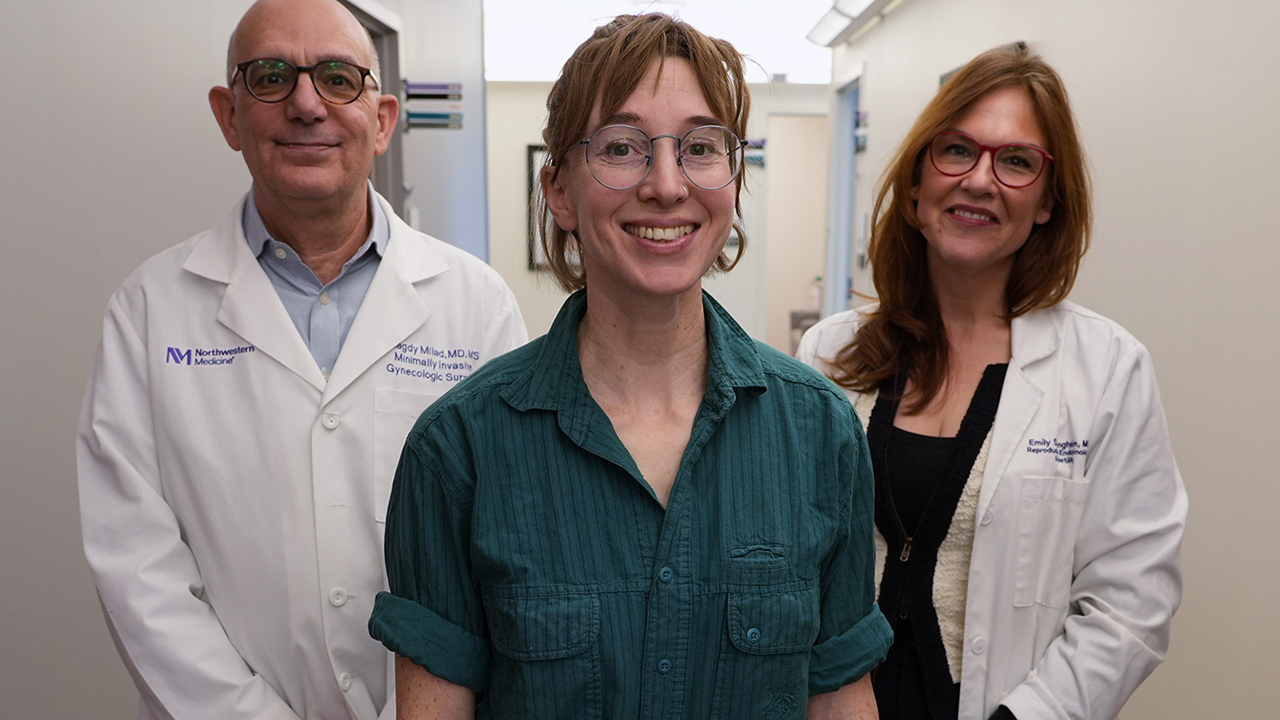
Iona Woolmington, a Chicago cartoonist, learned she had stage 3 rectal cancer at age 35.
“Iona’s tumor was located deep within her pelvis, which is a complicated area,” says Mary F. Mulcahy, MD, a medical oncologist and hematologist at Northwestern Medicine. “Chemotherapy and radiation would be necessary to shrink the tumor before surgical removal. However, these treatments would likely impact her egg quality, damage her ovaries and trigger premature menopause.”
Given all the challenges ahead, Iona faced a difficult choice: Go through intense treatment immediately or find a way to protect her ovaries first.
Dr. Mulcahy referred Iona to specialists at Northwestern Medicine Center for Fertility and Reproductive Medicine, who recommended a fertility-sparing approach that included two steps:
- Egg banking: Removal and freezing of eggs for later use in fertility treatments, such as in vitro fertilization (IVF).
- Ovarian transposition: A surgical procedure that protects the ovaries from the damaging effects of radiation by moving them out of the treatment area.
“When we see a patient early on, the goal is to do as much as we can to potentially preserve the possibility of having a child down the road,” says Emily S. Jungheim, MD, chief of reproductive endocrinology and infertility at Northwestern Medicine. “Iona was young, and so we knew the eggs we got were going to be high quality. By examining the ovaries with ultrasound, we can estimate the potential number of eggs available for egg banking, and we were pleased to see that things looked good for Iona.”
Egg banking, combined with ovarian transposition, put Iona on track to preserve her future reproductive health.
How Ovarian Transposition Works
During this procedure, surgeons move the ovaries, which are normally located in the pelvis, into the abdomen — placing them as far away from the field of radiation as possible to help avoid injury. “By doing so, we protect the patient from premature menopause and the associated risks of cardiovascular disease, osteoporosis, cognitive decline and even early death,” says Magdy P. Milad, MD, chief of minimally invasive gynecologic surgery at Northwestern Medicine.
Research shows that ovarian transposition, also known as ovarian suspension, oophoropexy or ovariopexy, can successfully preserve ovarian function, with success rates ranging from 70% to 90%.
The Next Phase of the Plan: Chemotherapy, Radiation and Colon Surgery
After successfully freezing her eggs and moving her ovaries out of the field of radiation, Iona began chemotherapy and radiation to treat her cancerous tumor. Six months later, Iona’s physicians determined she had responded well enough to have a type of surgery called a colon resection.
In this surgery, surgeons removed the cancerous part of Iona’s rectum and sewed the healthy parts back together. While her gastrointestinal tract healed, she was given a temporary ileostomy bag, or ostomy pouch, which is worn on the outside of the body to collect waste and prevent it from entering the large intestine and rectum.
“For patients with colorectal cancer, chemotherapy doesn’t typically cause you to lose your hair, so the ileostomy bag was the most concrete change in my experience with cancer,” says Iona, who now shows no signs of cancer after her treatment plan. “I was initially very concerned about living with my ileostomy but ended up being very wrong about how much of an impact it had on my day-to-day life. That made me want to write about it.”
To raise awareness for colorectal cancer (including cancers of the colon and rectum), which is becoming increasingly common in people under the age of 50, and to illustrate the ways young adults are uniquely impacted by cancer, Iona created a comic book about her experience under the pen name Iona Fox.
“The fact that my Northwestern Medicine medical team not only helped me beat cancer but also helped me come out of it with my 35-year-old body still intact, with the door still open on parenthood — there are no words to express my appreciation for that,” says Iona.
Learn more about when and why you need a colonoscopy — and how to prep for it.
Featured Experts



 Chrome
 Edge
Edge Safari
 Firefox