

The Cochlear Implant Option: Is It Right for You?
Better Hearing for Severe Loss
Updated November 2025
Hearing loss can sneak up on you. It often starts slowly and worsens over time. For many people, hearing aids are the first step in treating hearing loss. These small devices help by making sounds louder so damaged ears can hear better. But sometimes, hearing aids aren’t enough, especially when the tiny hair cells in the inner ear (called the cochlea) are too damaged to send clear sound signals to the brain.
Optimizing hearing is a vital step in supporting brain function as we age.— R. Mark Wiet, MD
That’s where cochlear implants come in. These compact electronic devices can help people with severe hearing loss or those who are born deaf hear better and understand speech more clearly. Cochlear implants may also help preserve or improve hearing for people diagnosed with acoustic neuroma.
How Do Cochlear Implants Work?
Unlike hearing aids, which use the ear’s natural hearing pathway, cochlear implants bypass the damaged parts of the ear. They send electrical signals directly to the auditory nerve, helping the brain recognize sounds.
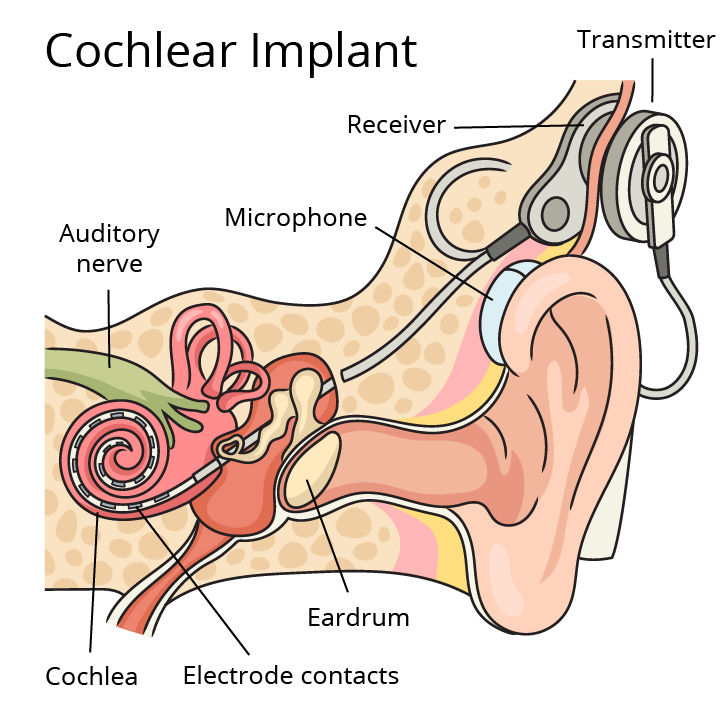
Here’s how they work:
- A microphone and sound processor worn behind the ear picks up sounds from the environment.
- The processor turns these sounds into electric impulses, or signals.
- These impulses travel to a receiver placed under the skin behind the ear.
- From there, they go to electrodes (tiny wires) inserted into the cochlea.
- The electrodes stimulate the auditory nerve, which sends the signals to the brain.
The brain then interprets these signals as sound. It’s not exactly like natural hearing, but with time and practice, many people learn to understand speech and enjoy sounds again.
“In cases of significant hearing loss where there is little or no benefit from traditional hearing aids, your care team may recommend a cochlear implant to provide the perception of sound,” says Alan G. Micco, MD, an otolaryngologist at Northwestern Medicine.
Who Is a Good Candidate?
Getting evaluated to see if you are a candidate for a cochlear implant involves a few steps.
- First, your care team will perform a CT or MRI scan to determine if a cochlear implant can be easily inserted. If there is narrowing in your inner ear channels, a special electrode array may be necessary. The surgeon needs to know if there is anything unique about your ear that would affect the surgery or possible outcomes.
- Next, audiologists will do special hearing tests to confirm that your scores meet the eligibility criteria for a cochlear implant. These tests are typically done with and without the use of hearing aids in a quiet, sound-treated room. The tests evaluate your sensitivity to tones and word recognition.
“In general, someone who cannot understand speech well enough to use the telephone, or someone who uses the phone with difficulty, is likely to be a good cochlear implant candidate,” says R. Mark Wiet, MD, a neurotologist at Northwestern Medicine. “The telephone transmits only auditory information and does not provide access to visual cues, so it is a quick estimate of someone’s speech understanding.”
From Surgery to Sound
If you're approved for a cochlear implant, your team will schedule you for surgery, which takes about 90 minutes. The surgery is done under general anesthesia, so you’ll be asleep and won’t feel the procedure while it’s happening. Most people go home the same day.
After surgery, there’s a waiting period — typically one to four weeks — before the device is fully activated or essentially turned on. Once it’s activated, sounds may seem strange or robotic. That’s normal. Your brain needs time to get used to the new way of hearing. Most people start to notice improvements in understanding speech within three to six months. The key is to wear the speech processor every day and practice listening.
“It’s common for speech to sound unclear on the first day of activation,” says Dr. Wiet. “This usually improves quickly as the brain adapts to the new way of hearing.”
Support and Rehabilitation
Learning to hear with a cochlear implant takes time and effort. You’ll work with audiologists and speech-language pathologists to train your brain to understand sounds. You might use apps, listening exercises or group therapy.
Regular follow-up visits are important. Your care team will adjust the device, check your progress and help you get the most out of your implant.
Risks and Recovery
Cochlear implant surgery is generally safe, but like any surgery, there are risks. These can include:
- Infection
- Dizziness
- Nerve damage
- Tinnitus (which can also improve with the implant)
- Loss of remaining natural hearing in the implanted ear
Your care team will talk to you about these risks and help you manage them.
Everyday Benefits
People with cochlear implants often say they can:
- Hear speech without needing to read lips
- Recognize everyday sounds like birds chirping or a doorbell
- Talk on the phone
- Enjoy music again
- Communicate better in noisy places
The Link Between Hearing Loss and Cognitive Decline
Research has shown a connection between hearing loss and cognitive decline. As hearing loss progresses, the brain has to work overtime to make sense of sounds and fill in the missing pieces of conversation. This increased mental effort can divert resources away from memory and thinking processes, potentially contributing to cognitive decline over time.
Social isolation also plays a role in brain health. People with untreated hearing loss often withdraw from social interactions because conversations become frustrating and exhausting. Reduced engagement with others can lead to loneliness, depression and fewer opportunities to stimulate the brain, which are factors known to heighten the risk of cognitive decline.
Hearing aids, cochlear implants and other assistive listening devices can help maintain communication abilities and keep the brain more active.
“Optimizing hearing isn’t just about clearer conversations. It’s also a vital step in supporting brain function as we age,” says Dr. Wiet. “We’re seeing a lot more patient awareness around this connection.”
Real Experiences, Real Impacts
Pamela
Even with her bilateral hearing aids, Pamela, 73, was having a hard time hearing. Her hearing deficit created challenges in social situations.
“My nephews visited in the fall of 2024 and that’s when I became profoundly aware of my hearing loss. It was so exciting to visit with them and their families, but I had to strain to hear them, to understand them, and it was quite depleting,” says Pamela.
In December 2024, she went in for her annual hearing test at Northwestern Medicine and her suspicions of hearing decline were confirmed. Four months later, she had cochlear implant surgery, which was performed by Dr. Wiet at Northwestern Medicine Delnor Hospital. She went home the same day.
Three weeks after surgery, Pamela went to an appointment to activate the implant. She was instantly moved to tears.
“A lot of times you don't realize what you're missing. I'm hearing sounds I haven't heard in probably years, and it's pretty remarkable,” says Pamela. “Hearing deficit touches really every aspect of your life.”
Liz
Liz, 59, has had bilateral cochlear implants for more than a decade and hears much of what she needs to hear. People are almost always surprised to learn she has any hearing impairment. She credits much of this to the different programs or settings the cochlear implant offers for different noise environments.
“The audio zoom program is incredible for noisy environments,” says Liz. “My family has noticed that, with my bionic ears, I can sometimes hear better in noise than they can.”
“People may ask, ‘how well do the cochlear implants work for you?’” Liz continues. “Well, just the fact I can answer someone’s question at all is amazing. Before my implants, I had only 4% comprehension. My cochlear implants have given me back the joy of relationships. Perhaps the best thing I can say is that sometimes I forget I have a hearing impairment at all.”
Patrick
Cochlear implants also helped Patrick reconnect socially, restoring a sense of belonging that had been missing. Since he began to lose his natural hearing at age 14, Patrick relied heavily on hearing aids as his hearing continued to decline. But with cochlear implants, he could see a future — both personally and professionally.
“Although the hearing from my bilateral cochlear implants is less than perfect, I have welcomed back to my life the intimacy that only stress-free communication can provide,” says Patrick. “The cochlear implant team at Northwestern Medicine provided care and comfort every step of the way from the pre-surgical tests and consults through the surgery and follow-up programming, some of which will continue for the rest of my life. Relearning to hear with a cochlear implant is not easy. But every day that you do so is elating.”



 Chrome
 Edge
Edge Safari
 Firefox