


A Rare Breast Cancer Complication Didn’t Stop This Grandmother
Finding Strength After a Leptomeningeal Disease Diagnosis
When Michelle Wilcox was heading to the pool one morning in Florida, she expected an ordinary day.
I really hope that we can offer this type of therapy to more patients.— Robin A. Buerki, MD
Instead, she was hit with sudden nausea, vomiting and trouble keeping her balance.
What seemed like a sudden illness turned out to be something far more serious. Her breast cancer had returned and spread to her brain.
For Michelle, the diagnosis marked an unexpected journey that would include brain surgery, specialized cancer treatment and precious time with her family.
When Breast Cancer Returns
Michelle, who splits her time between St. Charles, Illinois, and Naples, Florida, was first diagnosed with breast cancer in 2017.
After a double mastectomy, chemotherapy and radiation therapy, she spent years cancer-free.
Then new symptoms appeared.
Doctors discovered a tumor in her brain that required urgent surgery.
Later, she developed double vision and numbness near her tailbone. Additional testing revealed that cancer cells had spread to the lining surrounding her brain and spinal cord.
The diagnosis was leptomeningeal disease.
“When someone tells you that you have a month to live, you start planning your funeral,” says Michelle. “There was talk of picking out a church and a casket. But something in me said, ‘I’m not done yet.’”
What Is Leptomeningeal Disease?
Leptomeningeal disease, also called leptomeningeal metastases, occurs when cancer cells spread to the thin layers of tissue surrounding the brain and spinal cord.
Although rare, this complication affects about 2% to 5% of people with breast cancer. It most often develops after breast cancer has spread beyond the breast. The condition can also occur with other cancers, including lung cancer and melanoma.
When cancer cells spread to these tissues, they can enter and travel through cerebrospinal fluid, a clear fluid that helps cushion and protect the central nervous system. It also helps deliver nutrients and remove waste.
Because the condition affects the brain and spinal cord, it can cause a wide range of symptoms, including:
- Vision changes
- Hearing problems
- Difficulty walking
- Balance issues
- Weakness
- Changes in swallowing or breathing
Without treatment, leptomeningeal disease can progress quickly.
A Critical Decision and a New Chance at Life
Michelle and her husband, Keith, returned to Illinois and met with Robin A. Buerki, MD, a neuro-oncologist at Northwestern Medicine who specializes in tumors affecting the brain and nervous system.
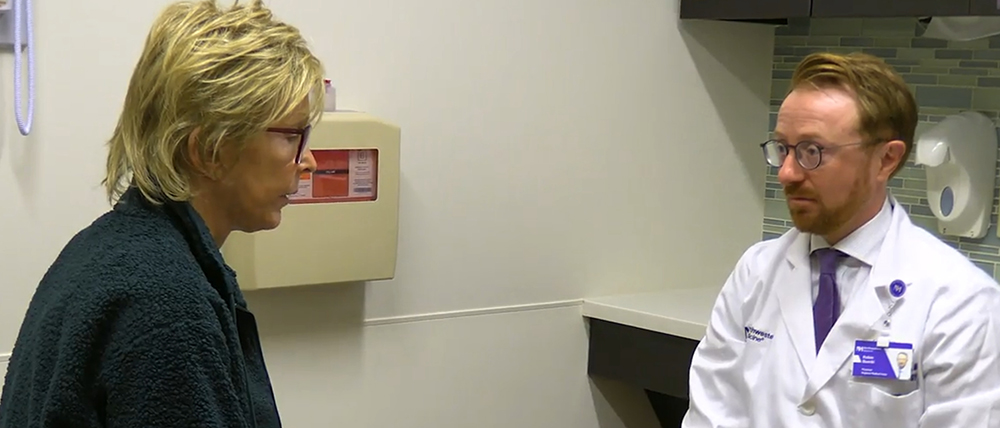
“She developed new areas of disease in the brain, spinal cord and spinal fluid,” says Dr. Buerki. “Leptomeningeal metastases are often rapidly progressive and fatal. Many patients will only survive weeks after diagnosis. But with timely, aggressive therapies, some can respond to treatment.”
Vinai Gondi, MD, director of radiation oncology and codirector of the Brain Tumor Center at Northwestern Medicine Proton Center and Northwestern Medicine Cancer Center Warrenville, joined Michelle’s treatment team.
Together, they recommended a combination of radiation therapy and intrathecal chemotherapy, a treatment that delivers cancer-fighting medication directly into the spinal fluid.
Because many cancer medications do not easily reach the cerebrospinal fluid, this approach helps deliver treatment where it is needed most.
“‘That’s what you need, and you need it now,’” Michelle recalls Dr. Buerki saying. “‘We have a small window to do this.’”
Michelle sought opinions from other institutions before deciding where to receive treatment.
“I feel like we made the absolute right choice going with Northwestern Medicine,” says Michelle. “Look at me. I’m still here a year later. I’m able to function on my own. I get to be with my grandkids. It’s amazing.”
A Strong Response to Treatment
Michelle underwent 10 rounds of radiation therapy and began receiving intrathecal chemotherapy twice a week. She continues to receive intravenous chemotherapy to manage her metastatic breast cancer.
“Michelle has had a fantastic response,” says Dr. Buerki. “Her spinal fluid no longer shows the abundant cancer cells that were present before treatment. Her MRIs show no continued disease.”
Dr. Buerki added that when she first arrived for treatment, he expected she might survive only a few weeks.
“Now, more than a year later, she is thriving,” he says. “Seeing a patient not only respond to treatment but continue to enjoy life, spend time with grandkids and travel — that is absolutely wonderful.”
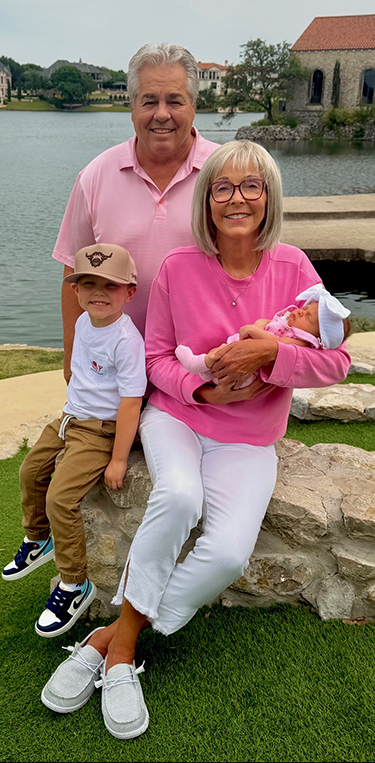
their grandchildren, Leyton and Kennedy.
Focusing on Family
Today, Michelle continues treatment and regular monitoring. Her focus, however, is on the moments that matter most.
She recently traveled to meet her sixth grandchild and continues spending time with her family whenever possible.
For Michelle, those experiences carry even greater meaning after everything she has been through.
“I’m here for a reason,” she says. “If someone else gets this diagnosis, I want them to know it’s not necessarily doom and gloom. There is hope. I was told I had a month, and now it’s been over a year.”
Michelle’s symptoms came on suddenly, but symptoms of leptomeningeal disease can vary from person to person.
People with a history of cancer should tell their physician about any new neurological symptoms, such as:
- Persistent headaches
- Vision changes
- Difficulty walking
- Balance problems
- Weakness
- Numbness
While these symptoms can have many possible causes, early evaluation can help physicians determine what is causing them and begin treatment if needed.
Why Early Evaluation Matters
Dr. Buerki says Michelle’s experience highlights the importance of starting treatment as soon as possible.
“I really hope that we can offer this type of therapy to more patients,” he says. “It is something that is very time sensitive. For some patients, there can be a window of opportunity and when we are able to start quickly, as we did for Michelle, it is critical and I think helps with these good results.”


 Chrome
 Edge
Edge Safari
 Firefox