


What Is Aphasia? One Woman’s Recovery Story
From Aphasia to Confidence and Connection
Published October 2026
For years, Linda Budziak spent her days talking with children, parents and families through her in-home daycare business.
But an unexpected accident put those everyday conversations at risk.
While visiting friends in Indiana, Linda went for a bike ride. As the ride was winding down, rain began to fall. She lost control of her bicycle and crashed.
Over the course of her involvement, she has just blossomed.— Michelle Armour, MS, CCC-SLP
The accident left her with a traumatic brain injury, a brain bleed, and broken bones in her hip and leg. Emergency brain surgery saved her life, but the road to recovery was just beginning.
When Linda woke up from a coma more than a week later, she noticed something was different.
“I could understand that my speech wasn’t right,” says Linda. “I’m a talking person, so that was hard for me.”
What Linda was experiencing was aphasia, a communication disorder caused by damage to the brain.
Learning to communicate again would become one of the biggest challenges of her recovery.
What Is Aphasia?
Aphasia is a language disorder that affects a person’s ability to communicate. It can make it difficult to speak, understand language, read or write.
“At the core of it, a person with aphasia knows what they want to say, but they just have difficulty putting it into words,” says Michelle Armour, MS, CCC-SLP, founder and program manager of Northwestern Medicine Aphasia Center at Marianjoy Rehabilitation Hospital.
Symptoms of aphasia can vary depending on which areas of the brain are affected. Common symptoms include:
- Difficulty finding the right words
- Speaking in short or incomplete sentences
- Trouble understanding conversations
- Difficulty reading or writing
- Using the wrong words or sounds when speaking
Aphasia is most often caused by a stroke. It can also develop after a traumatic brain injury or other changes involving the brain.
The condition affects everyone differently. Some people struggle to find words. Others may have difficulty reading, writing or following conversations. These challenges can affect relationships, work and daily activities.
How Is Aphasia Treated?
Treatment for aphasia often begins with speech-language therapy. A speech-language pathologist can help people improve communication skills and develop strategies for everyday conversations.
Therapy may focus on:
- Practicing speaking and finding words
- Improving reading and writing skills
- Strengthening comprehension
- Learning alternative ways to communicate, such as gestures, drawings or communication devices
In addition to one-on-one therapy, support groups and community programs can help people practice communication skills in real-world situations and build confidence.
Starting treatment early can be beneficial, but recovery doesn’t follow a set timeline. People may continue to gain new skills and strategies months or even years after their injury or illness.
When Communication Changes Overnight
Following her accident, Linda began rehabilitation and worked to regain skills many people take for granted.
One of the biggest challenges was communicating with others. For someone who had always been outgoing and social, those changes were especially difficult.
The Aphasia Center at Marianjoy became an important part of her recovery.
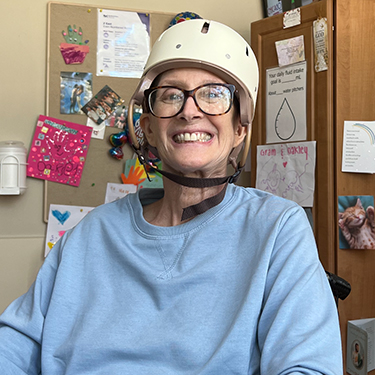
Marianjoy Rehabilitation Hospital.
The community-based program gives people with aphasia opportunities to practice communication skills, build confidence and connect with others who understand what they’re going through.
“Our main goal is to help individuals not only continue to improve their communication, no matter how long it’s been since their injury, but also help them connect with other people who have similar experiences,” says Armour.
The Power of Connection
For many people with aphasia, communication challenges can lead to isolation.
“When communication changes unexpectedly from a stroke or brain injury, social circles can shrink and people can feel isolated,” says Armour. “By providing this safe space where everyone understands what it’s like to have trouble communicating, it creates a new community and helps people avoid that isolating feeling.”
At first, Linda was hesitant to participate.
“When Linda first joined our program, she was very quiet and a little nervous,” says Armour. “Over the course of her involvement, she has just blossomed.”
Linda remembers how difficult those early days felt.
“I literally sat there and I couldn’t even read a sentence,” she says.
But something began to change. Listening to other people share similar experiences helped her realize that she wasn’t alone.
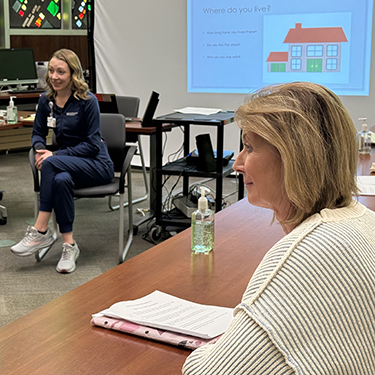
take part in a support group at the Northwestern Medicine
Aphasia Center at Marianjoy Rehabilitation Hospital.
“After three weeks, I was a different person,” says Linda. “Talking to other people who had injuries or strokes helped me so much. I always told myself, ‘I’m going to get better. I’m not going to give up.’”
Getting Back to Life
As her confidence grew, Linda’s communication continued to improve. The progress extended far beyond the Aphasia Center at Marianjoy.
She eventually returned to running her licensed in-home daycare business full time, something that once seemed impossible.
The experience also sparked an unexpected new interest.
“I literally have a love for reading, which I never did,” says Linda. “It’s also given me a love to help people and to talk to people again.”
Today, Linda continues participating in the Aphasia Center and volunteers every week at Marianjoy Rehabilitation Hospital.
She often welcomes people who are new to the program and reassures them that improvement is possible.
“If you’re having a hard time, you come here, you talk to other people and you go home feeling better,” says Linda. “Being around other people keeps you motivated.”
Living Well With Aphasia
While aphasia can affect communication in many ways, recovery doesn’t stop after rehabilitation ends.
According to Armour, continuing to practice communication skills and staying connected with others can make a significant difference.
The goal is not simply improving speech. It’s helping people participate in the activities, relationships and communities that matter most to them.
For Linda, that has meant returning to the conversations she loves, helping others and continuing to do work that gives her purpose.
Today, she uses her experience to encourage others facing many of the same challenges she once did.
And after everything she has been through, she isn’t taking those moments for granted.
 Chrome
 Edge
 Safari
 Firefox